Crop wild relatives are valuable sources of genetic diversity that may help develop cultivars with better tolerance to environmental stresses and more efficient use of resources.
At Wageningen University & Research (WUR), researchers are exploring the potential of wild lettuce (Lactuca serriola) to improve cultivated lettuce (Lactuca sativa). The aim is to understand how genetic variation from wild lettuce can contribute to traits that are important for sustainable lettuce production.
Characterization of a wild lettuce diversity panel under phosphorus deficiency
Phosphorus is an essential nutrient for plant growth, and we are running out. The phosphorus used in fertilizer is mined from phosphate rock, a limited recourse of which shortages are predicted to occur within the current century. As such, getting our crops to grow well with less phosphorus would be extremely beneficial.
Prickly lettuce (L. serriola) grows in a wide range of environments with varying availability of phosphorus. As such, it is expected that some wild lines will harbor adaptations that improve acquisition and usage efficiency of phosphorus. To study this, a panel of ~150 genotypes of L. serriola were grown under phosphorus limiting conditions. Plant growth and health was monitored throughout the growing period, and the harvested material is currently being evaluated for its phosphorus contents.
This work has already revealed that there is a broad range of responses in L. serriola under phosphorus deficiency. There are differences in both the amount of phosphorus acquired and the amount of phosphorus needed per unit of biomass, indicating that different types of adaptations exist in the wild material. Analysis of the complete dataset will be combined with environmental and genetic data to provide a wholistic view of the phosphorus deficiency response in L. serriola. From this the most promising candidate lines will be selected for follow up research.
Can genome-wide association studies unlock the genetic potential of crop wild relatives?
Crop wild relatives (CWRs) are a valuable reservoir of genetic diversity that could help develop improved crop varieties. However, tapping into this diversity requires effective tools to identify the genes and genetic variants responsible for important traits. Genome-wide association studies (GWAS) are widely used to link genetic markers to traits of interest. But how well do these methods work in crop wild relatives, whose genetic diversity and population structure can differ considerably from domesticated crops?
To investigate this, researchers at Wageningen University evaluated the performance of GWAS using real genomic data from lettuce, maize, and their respective wild relatives, combined with simulated phenotypes. In each simulation, a randomly selected genetic variant was designated as causal and used to generate a phenotype. We then performed GWAS to assess how successfully the analysis could identify the causal variant.
The results reveal a substantial gap between domesticated crops and their wild relatives. Even when causal variants had large effects, only 15–25% of simulations in CWR populations successfully identified the true causal variant, compared with approximately 60% in domesticated populations. This difference became even more pronounced when causal variants had smaller effects.
Two key factors help explain this reduced performance: the higher frequency of rare genetic variants in CWR populations and their complex population structure. Rare variants, which are particularly common in wild populations, are considerably more difficult to detect through GWAS. Meanwhile, correcting for population structure, although essential to avoid false associations, can substantially reduce the statistical power to detect genuine associations.
Our findings highlight an important challenge: greater genetic diversity does not necessarily translate into greater power to identify useful genetic variants through GWAS. To achieve similar power in crop wild relatives compared to crops, you will need either larger diversity panels, or focus more on sampling local variation rather than trying to maximize diversity.
Additionally, this work shows that there is still much to be gained from the construction of mapping populations like biparental or magic populations, as these avoid the issues of rare variants and mitigate many of the problems with population structure.
The construction of a backcross population between wild and domesticated lettuce
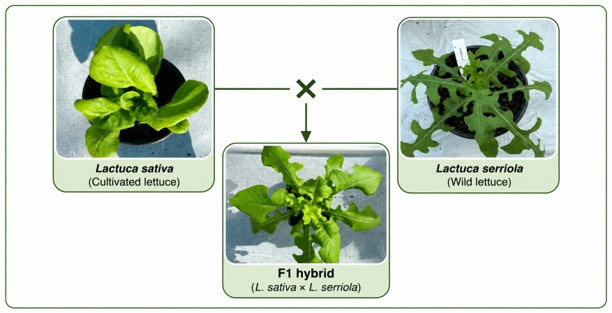
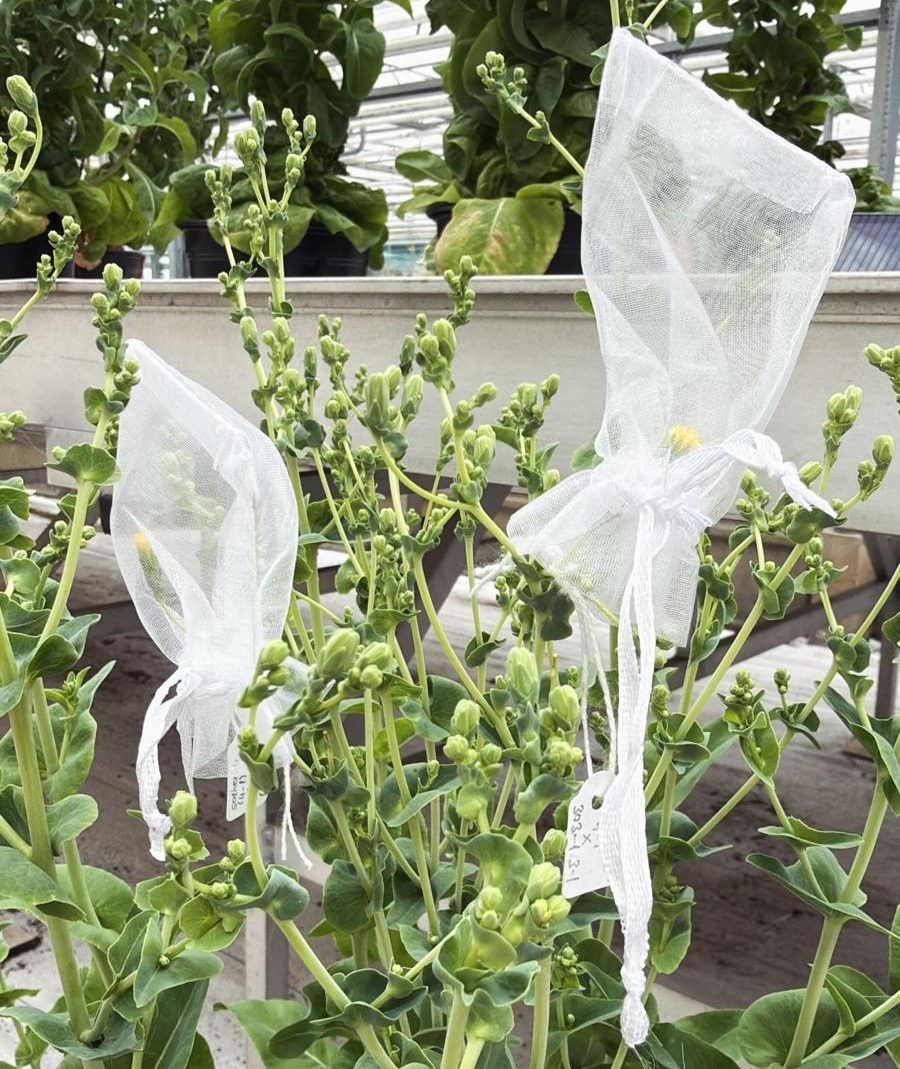
As the work above highlights, crossing populations between wild and domesticated materials are valuable tools for investigating the genetic basis of traits. At WUR, crossing experiments were carried out using two cultivated lettuce genotypes and 11 different L. serriola accessions provided through the COUSIN project. The main objective is to develop early-generation introgression material by transferring different, potentially overlapping genomic segments from selected wild lettuce accessions into the genetic background of cultivated lettuce. This will allow researchers to study how genetic variation from wild lettuce affects traits in cultivated lettuce.
A total of 22 parental combinations were targeted, and F1 hybrid plants were successfully obtained from 16 combinations. These hybrids will be used as starting material for the next stages of the research.
Evaluation of phosphorus use efficiency and tipburn susceptibility
The next step is to evaluate the F1 hybrids and parental lines for phosphorus use efficiency and tipburn susceptibility. Phosphorus is essential for plant growth, but its availability to plants is often limited. Improving phosphorus use efficiency could help reduce fertilizer use and support more sustainable production. To investigate this, plant growth, biomass production, and root system architecture will be assessed under different phosphorus levels. These experiments will help identify differences in how the plants respond to phosphorus limitation.
The research will also examine variation in tipburn susceptibility. Tipburn is a physiological disorder that can cause significant quality losses in lettuce and is often associated with insufficient calcium supply to rapidly developing leaves. By comparing the parental lines and F1 hybrids under controlled conditions, researchers will assess differences in their susceptibility to tipburn.
Based on the phenotyping results, three promising hybrid combinations will be selected for further research. These combinations will be backcrossed to cultivated lettuce to develop early-generation populations carrying wild lettuce-derived genomic segments in a cultivated genetic background. The resulting plants will be used to investigate how these segments affect phosphorus use efficiency and tipburn susceptibility.
This work will help us better understand how genetic variation from wild lettuce influences important traits in cultivated lettuce. The plant material developed during the project may also be useful for future lettuce breeding.