
On 12 December 2025, an online stakeholder meeting was organized by the partner BETA Technological Center organized within the framework of the project COUSIN to discuss the role of crop wild relatives (CWR) in the development of more resilient and sustainable agricultural systems.
The main objective of the session was to gather stakeholder perspectives on which CWR-derived traits are most relevant for the future of agriculture and how these traits can be meaningfully evaluated in research and practice.
The meeting brought together a diverse group of participants representing plant breeding, farming, research, technical services and civil society. In addition, researchers from other ongoing initiatives working on crop wild relatives in Catalonia also participated, including the projects MAGICPIMPICERAS (UPC), BINAFET (UPC) and FRUITDIV (IRTA–CRAG). This multi-actor and multi-project setting enabled a rich exchange of perspectives across crops, disciplines and scales.
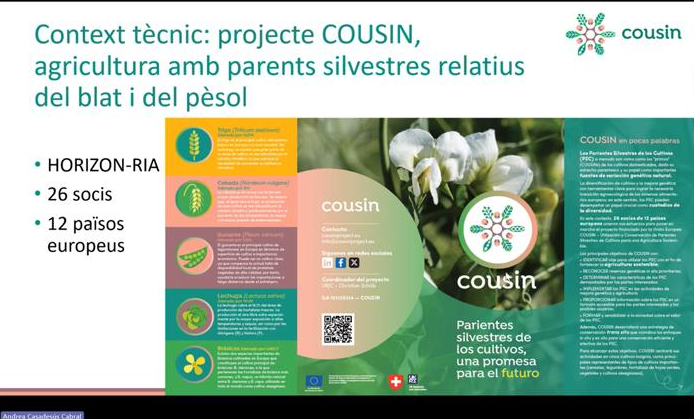
The discussion was framed by an overview of the COUSIN project and the activities currently being carried out in Catalonia by the Technological Centre BETA (UVic-UCC). Participants were introduced to the field-based research being conducted with wheat- and pea-related crop wild relatives, includingThinopyrum intermedium as a perennial cereal related to wheat, and pea lines incorporating wild relatives such as Pisum fulvum in their pedigree. The rationale for selecting these materials was explained in relation to their potential contribution to climate resilience, resource-use efficiency and the long-term sustainability of agricultural systems.
Insights from other projects complemented this overview and helped place the COUSIN activities in a broader research context. The MAGICPIMPICERAS project (UPC) presented work on the genetic and phenotypic basis of drought tolerance in tomato wild relatives, particularly Solanum pimpinellifolium and S. lycopersicum var. cerasiforme. The BINAFET project (UPC) shared perspectives on how domestication and modern breeding have shaped photosynthetic responses to changing CO₂ conditions in horticultural crops. In addition, the FRUITDIV project (IRTA–CRAG) contributed a fruit crop perspective, focusing on the use of genetic diversity and wild relatives to enhance resilience and diversification in perennial fruit systems. Together, these contributions highlighted the breadth of approaches currently being explored in Catalonia to harness CWR across different crop groups.
A central part of the meeting focused on an interactive exchange around three guiding questions: which traits of crop wild relatives are considered most relevant for the future of agriculture, what benefits these traits could bring to farming systems, and which types of evaluations or indicators are most useful to capture their value. The discussion addressed agronomic, physiological and functional traits, as well as the challenges associated with transferring CWR-derived traits into breeding programmes and agricultural practice.
Overall, the exchange revealed clear synergies between projects and a strong convergence around the importance of traits linked to resilience, stability under variable conditions and reduced dependency on external inputs. Participants emphasised the value of field-based evaluations, cross-project learning and continued dialogue between research, breeding and farming communities. The meeting concluded with a shared interest in maintaining these interactions over time, using the insights gathered to refine trait prioritisation and evaluation strategies within COUSIN and to strengthen collaboration among initiatives working on crop wild relatives in the region.
0 Comments