
On December 1th, the scientific journal The plant genome (volume 18, issue 4) published an article written by Sara Rodriguez-Mena, Maria Carlota Vaz Patto, Susana Trindade Leitão, Diego Rubiales, and Mario González entitled “Identification of genomic regions associated with partial resistance to Aphanomyces root rot in pea”
The research described in the publication was also funded by the COUSIN project.
Abstract
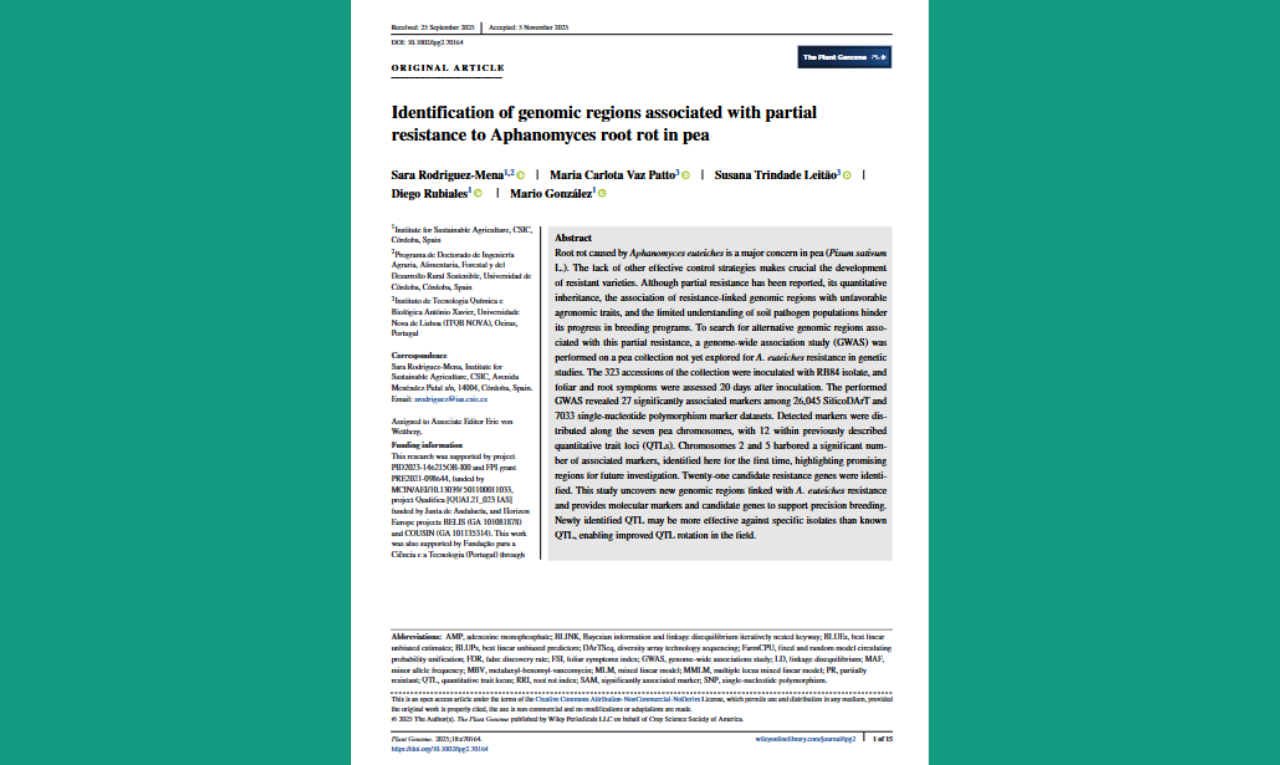
Root rot caused by Aphanomyces euteiches is a major concern in pea (Pisum sativum L.). The lack of other effective control strategies makes crucial the development of resistant varieties. Although partial resistance has been reported, its quantitative inheritance, the association of resistance-linked genomic regions with unfavorable agronomic traits, and the limited understanding of soil pathogen populations hinder its progress in breeding programs. To search for alternative genomic regions associated with this partial resistance, a genome-wide association study (GWAS) was performed on a pea collection not yet explored for A. euteiches resistance in genetic studies. The 323 accessions of the collection were inoculated with RB84 isolate, and foliar and root symptoms were assessed 20 days after inoculation. The performed GWAS revealed 27 significantly associated markers among 26,045 SilicoDArT and 7033 single-nucleotide polymorphism marker datasets. Detected markers were distributed along the seven pea chromosomes, with 12 within previously described quantitative trait loci (QTLs). Chromosomes 2 and 5 harbored a significant number of associated markers, identified here for the first time, highlighting promising regions for future investigation. Twenty-one candidate resistance genes were identified. This study uncovers new genomic regions linked with A. euteiches resistance and provides molecular markers and candidate genes to support precision breeding. Newly identified QTL may be more effective against specific isolates than known QTL, enabling improved QTL rotation in the field.
Read the article on the website or directly from the PDF below.
0 Comments