
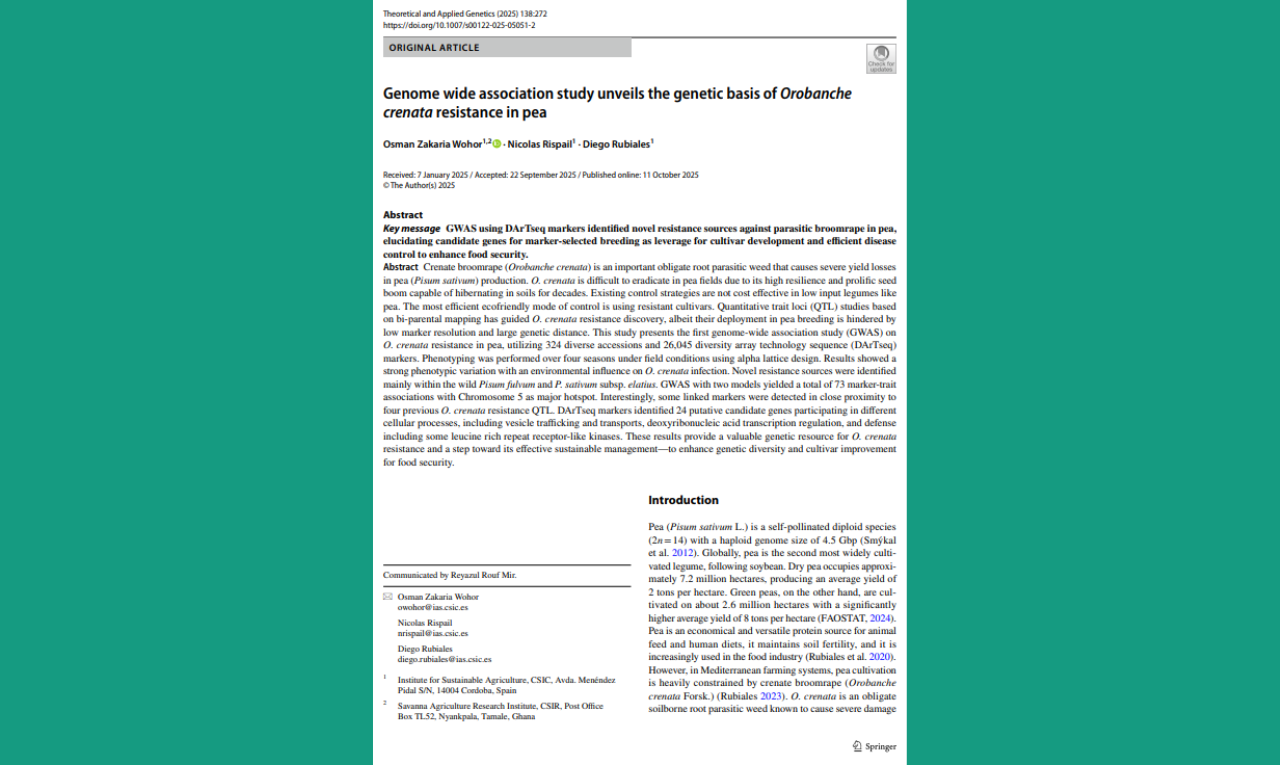
On October 11, the scientific journal Springer Nature Link (volume 138) published an article written by Osman Zakaria Wohor, Nicolas Rispail, and Diego Rubiales entitled “Genome wide association study unveils the genetic basis of Orobanche crenata resistance in pea”
The research described in the publication was also funded by the COUSIN project and concerns the genetic resistance of peas (Pisum sativum) to the parasitic weed Orobanche crenata, elucidating candidate genes for marker-selected breeding as leverage for cultivar development and efficient disease control to enhance food security.
Abstract
Crenate broomrape (Orobanche crenata) is an important obligate root parasitic weed that causes severe yield losses in pea (Pisum sativum) production. O. crenata is difficult to eradicate in pea fields due to its high resilience and prolific seed boom capable of hibernating in soils for decades. Existing control strategies are not cost effective in low input legumes like pea. The most efficient ecofriendly mode of control is using resistant cultivars. Quantitative trait loci (QTL) studies based on bi-parental mapping has guided O. crenata resistance discovery, albeit their deployment in pea breeding is hindered by low marker resolution and large genetic distance. This study presents the first genome-wide association study (GWAS) on O. crenata resistance in pea, utilizing 324 diverse accessions and 26,045 diversity array technology sequence (DArTseq) markers. Phenotyping was performed over four seasons under field conditions using alpha lattice design. Results showed a strong phenotypic variation with an environmental influence on O. crenata infection. Novel resistance sources were identified mainly within the wild Pisum fulvum and P. sativum subsp. elatius. GWAS with two models yielded a total of 73 marker-trait associations with Chromosome 5 as major hotspot. Interestingly, some linked markers were detected in close proximity to four previous O. crenata resistance QTL. DArTseq markers identified 24 putative candidate genes participating in different cellular processes, including vesicle trafficking and transports, deoxyribonucleic acid transcription regulation, and defense including some leucine rich repeat receptor-like kinases. These results provide a valuable genetic resource for O. crenata resistance and a step toward its effective sustainable management—to enhance genetic diversity and cultivar improvement for food security.