
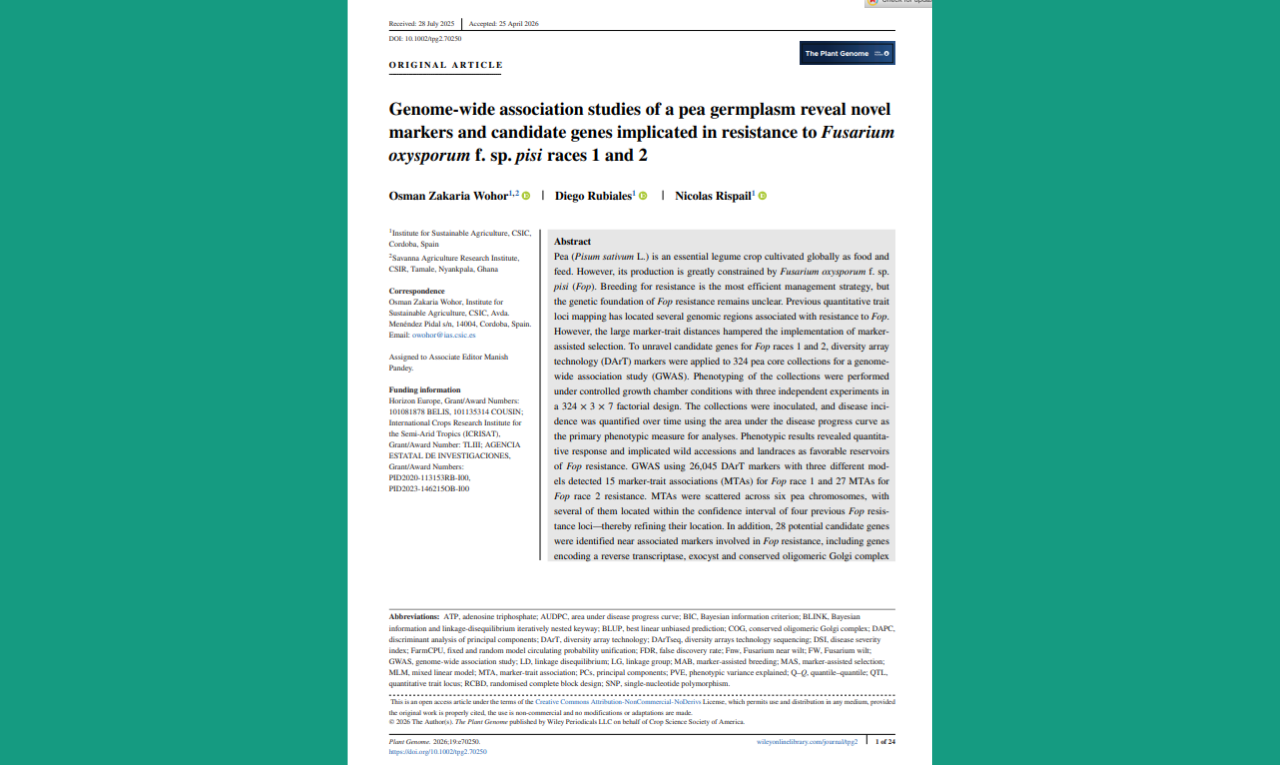
On May 2026, the scientific journal “The Plant Genome” published an article written by Osman Zakaria Wohor, Diego Rubiales, Nicolas Rispail entitled “Genome-wide association studies of a pea germplasm reveal novel markers and candidate genes implicated in resistance to Fusarium oxysporum f. sp. pisi races 1 and 2″.
Abstract
Pea (Pisum sativum L.) is an essential legume crop cultivated globally as food and feed. However, its production is greatly constrained by Fusarium oxysporum f. sp. pisi (Fop). Breeding for resistance is the most efficient management strategy, but the genetic foundation of Fop resistance remains unclear. Previous quantitative trait loci mapping has located several genomic regions associated with resistance to Fop. However, the large marker-trait distances hampered the implementation of marker-assisted selection. To unravel candidate genes for Fop races 1 and 2, diversity array technology (DArT) markers were applied to 324 pea core collections for a genome-wide association study (GWAS). Phenotyping of the collections were performed under controlled growth chamber conditions with three independent experiments in a 324 × 3 × 7 factorial design. The collections were inoculated, and disease incidence was quantified over time using the area under the disease progress curve as the primary phenotypic measure for analyses. Phenotypic results revealed quantitative response and implicated wild accessions and landraces as favorable reservoirs of Fop resistance. GWAS using 26,045 DArT markers with three different models detected 15 marker-trait associations (MTAs) for Fop race 1 and 27 MTAs for Fop race 2 resistance. MTAs were scattered across six pea chromosomes, with several of them located within the confidence interval of four previous Fop resistance loci—thereby refining their location. In addition, 28 potential candidate genes were identified near associated markers involved in Fop resistance, including genes encoding a reverse transcriptase, exocyst and conserved oligomeric Golgi complex subunits, a FERONIA-like receptor kinase, homoserine kinase, a heat shock 70 protein, adenosine triphosphate transporters, and multiple transcription factors and plant defense-related proteins. These putative genes and molecular pathways provide a foundation for the sustainable management of Fop.
Read the article on the website or directly frm the PDF below.